The Bible is not a lie. You’ve just been lied to about it.

I grew up in church. So I know this is a very hard truth to come to grips with.
The second someone starts asking questions about the Bible, a certain kind of anxiety kicks in. Like the questions themselves are dangerous. Like not knowing is safer than finding out. Like faith and understanding are somehow in competition with each other.
But the truth is the Bible never told you not to question it. That was added later, by people who had something to hide.
I love this text. I own multiple translations of it in my personal library. I consider it foundational. And I want more people to read it correctly. Which means understanding what it actually is, where it came from, who touched it along the way, and what tools you need to actually access what it is trying to say.
So if you have been sitting in church your whole life feeling like some things never fully added up, but nobody ever gave you permission to ask why, this is that permission.
Ask. Seek. Knock. The text literally told you to.
“Ask, and it shall be given you; seek, and ye shall find; knock, and it shall be opened unto you.” — Matthew 7:7
“It is the glory of God to conceal a thing: but the honour of kings is to search out a matter.” — Proverbs 25:2
A God big enough to create existence is not threatened by your curiosity. If your faith cannot survive your own questions, it was never faith. It was just inherited certainty. Traditions of man. There is a difference.
———
What You’re Actually Holding
The Bible is an ancient collection of texts written across approximately 1,500 years, by dozens of different authors, in multiple languages, across wildly different cultures and historical moments. The Old Testament was written in ancient Hebrew and some Aramaic. The New Testament was written in Koine Greek, which was the common street dialect of the ancient Mediterranean world. Not formal. Not ceremonial. Everyday language.
Between those original manuscripts and the English translation in your hand there are centuries of copying, translating, compiling, editing, debating, and decision-making by human beings with their own contexts, their own institutions, and their own reasons for the choices they made. That does not make the text less sacred. Sacred things move through human hands. That is actually the whole story of the Bible. But it does mean you need to know what those hands did.
The Hebrew in Your Bible Is Medieval
Almost every modern Bible translation of the Old Testament is built on something called the Masoretic Text. And most people who own a Bible do not know that this text was finalized between the 7th and 10th centuries AD. Not ancient. Medieval. We are talking about the same era as the Vikings and the early Islamic Caliphates.
Here is why that matters. Ancient Biblical Hebrew was written in consonants only. No vowels. This was intentional. The spoken language carried the vowel sounds and the written text was a skeleton that the reader filled in from living knowledge, community, and oral tradition.
A group of scholars called the Masoretes developed a system of vowel markings called nikud and inserted them into the text to preserve how it should be read and pronounced. This was a preservation effort done with genuine care and scholarship. But here is the reality: when you add vowels to a consonant text, you make interpretive choices. You are deciding what the word means, not just what it says. And once those choices became standardized, they became the floor that almost all of our translations stand on.
The Letters Were Alive Before the Words Were
Before the modern Hebrew script most of us picture, there was Paleo-Hebrew. And it descended from one of the earliest writing systems ever developed. In its original form, every letter was a pictograph. An image. Not just a sound. Each letter was a picture of something in the physical world, and that picture carried symbolic meaning that lived inside every word the letter was part of.
These writers were encoding meaning on multiple levels at the same time. The text was not just communicating what it said. It was communicating through the architecture of the language itself.
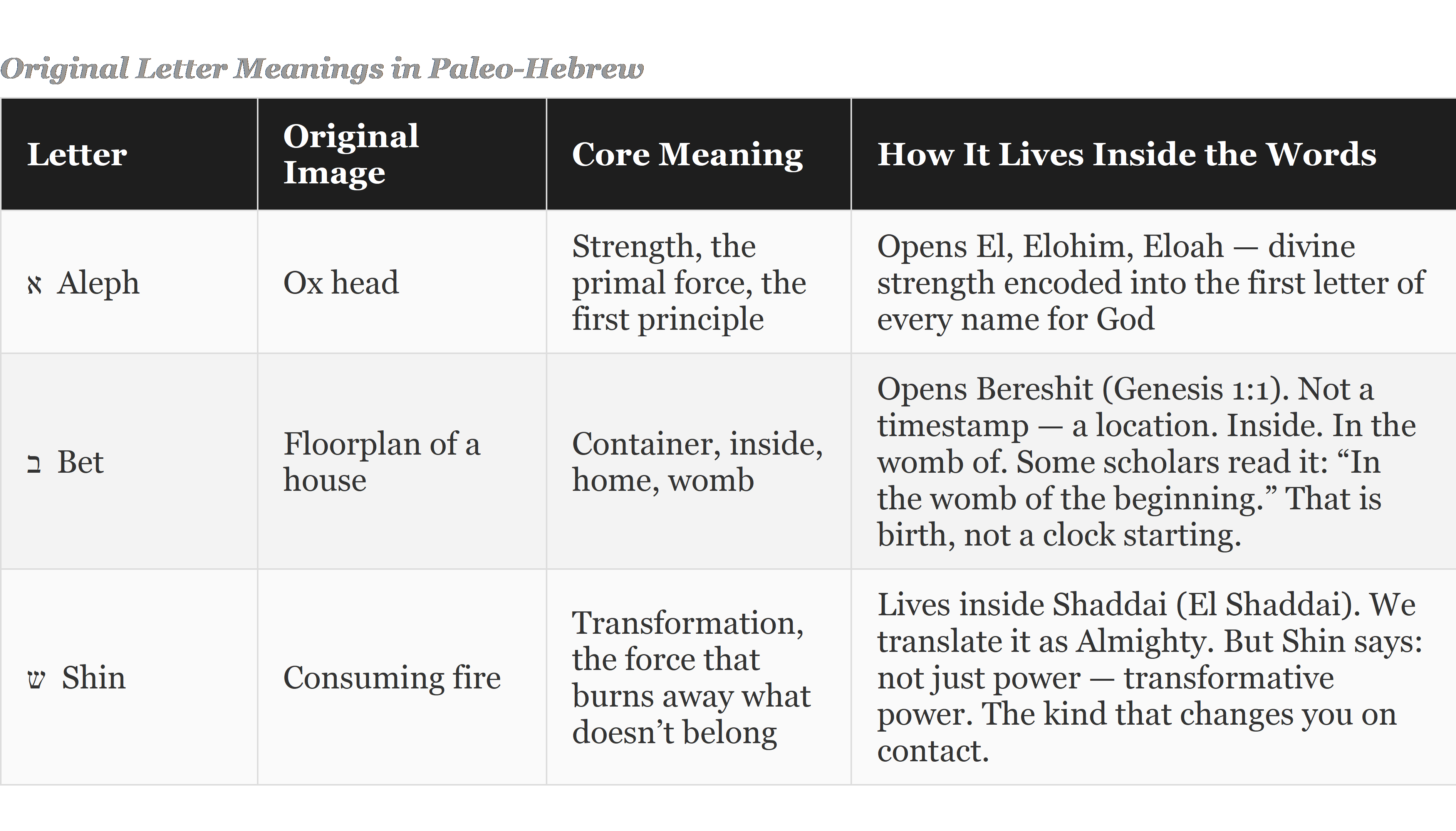
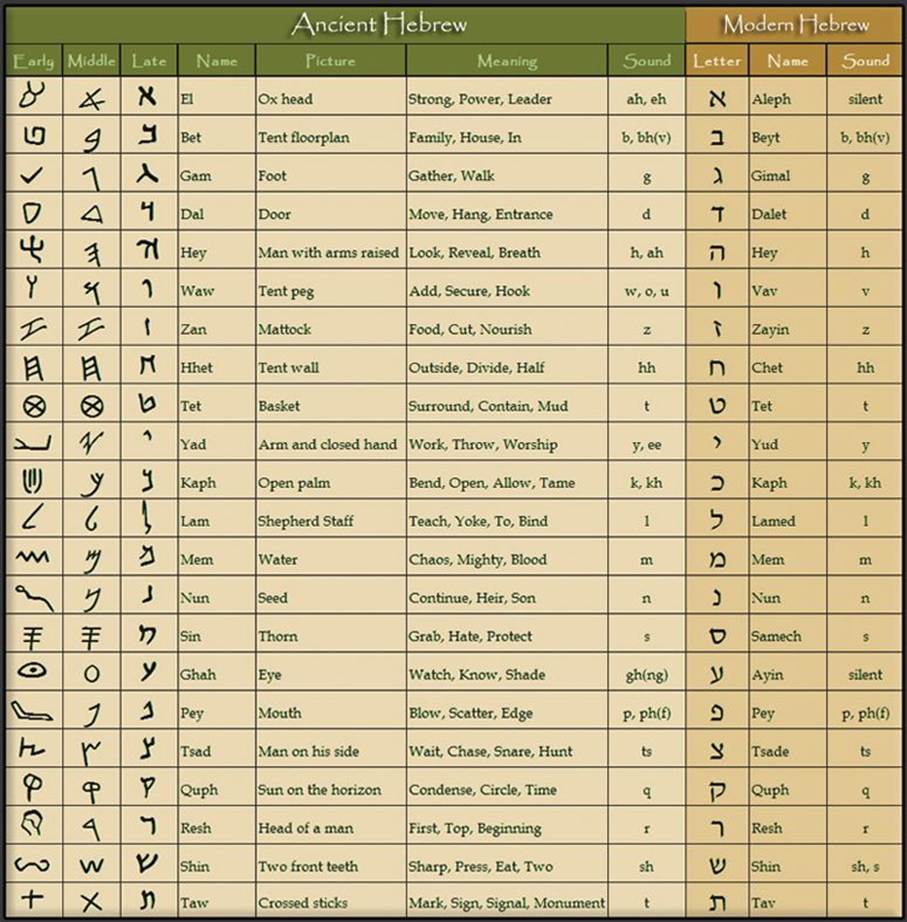
Most English translations are operating on the surface of a text that was built to communicate on multiple layers simultaneously. The scholars who wrote this were not casual. They were deliberate in ways most of us were never taught to look for.
———
“God” Is a Placeholder. Here Are the Seven Names It Replaced.
This is the part that genuinely changes how you read the text if you sit with it.
Modern English Bibles flatten at least seven distinct divine names into just two generic words: “God” and “Lord.” Every one of those names meant something specific. Each one revealed a different dimension of what the writers were pointing toward. When you lose the names, you lose the theology.
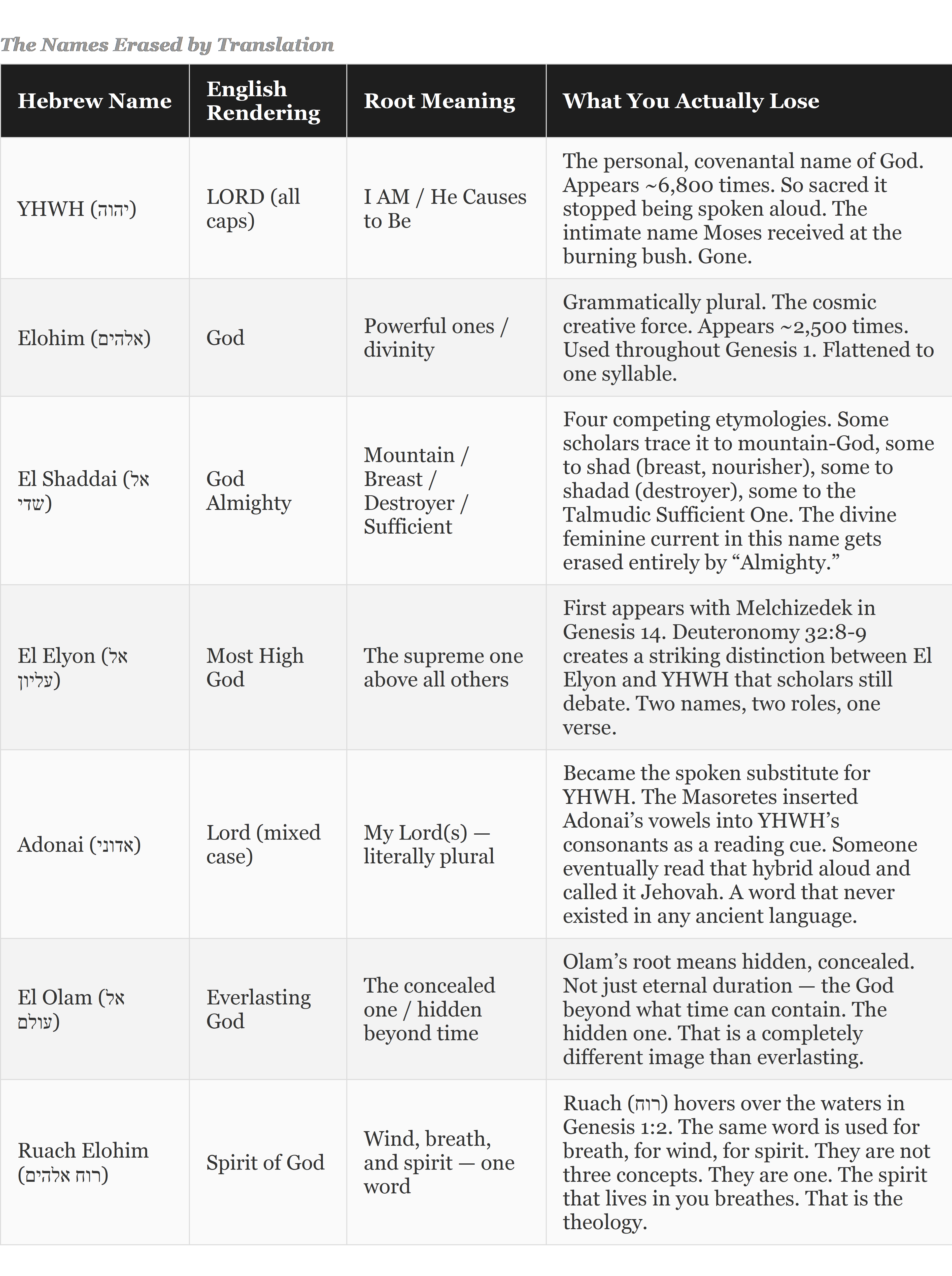
In the Old Testament, when the text shifts between these names, it is communicating something about which dimension of the divine is being expressed in that moment. The infinite cosmic creator or the intimate covenant keeper. Two modes of the same source, both real, both doing specific work. Flatten both into the same English word and that entire dimension disappears. You need the original to see it.
You have been praying to “God” your whole life without knowing which one you were addressing. That is not your fault. It is the translation’s.
———
His Name Was Not Jesus. And the J Is the Least of It.
The letter J did not exist in any written language until the 15th or 16th century. Italian grammarian Gian Giorgio Trissino formally distinguished I and J as separate letters in 1524. It was not universally adopted in English until the early 1600s. The original 1611 King James Bible used “Iesus” not Jesus. Also “Iames” for James. “Iohn” for John.
But the letter is honestly the smallest part of this conversation.
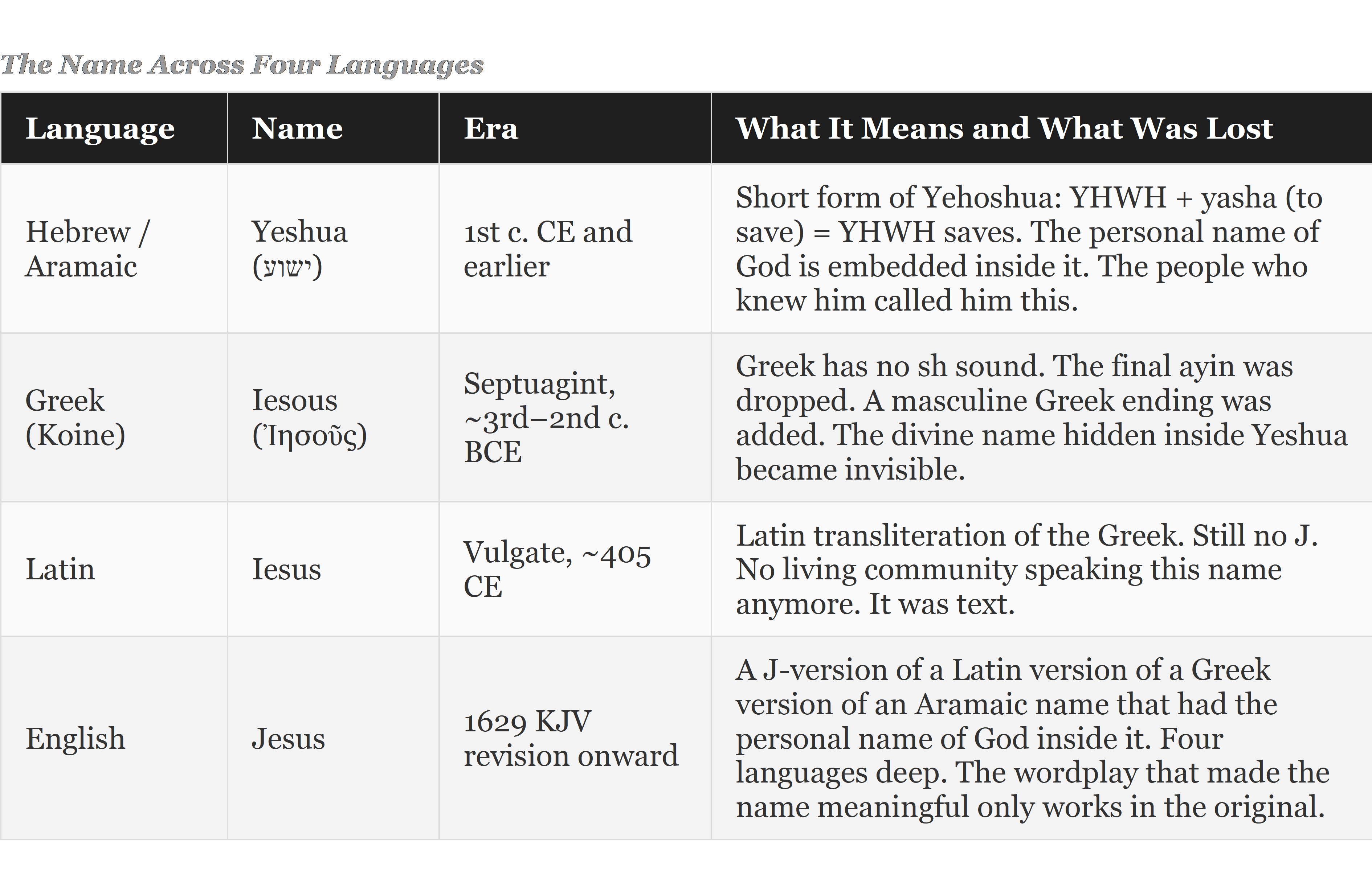
Joshua and Jesus are the same name. Hebrews 4:8 and Acts 7:45 both use the Greek Iesous to refer to Joshua son of Nun. Modern translations render those passages as “Joshua” to prevent confusion but the original text makes no distinction. They are the same word.
When the angel in Matthew 1:21 says thou shalt call his name Jesus: for he shall save his people from their sins, that is a direct wordplay on the meaning of Yeshua: YHWH saves. That wordplay only works in Hebrew and Aramaic. It completely evaporates in English.
And Jehovah? A word medieval European scholars accidentally constructed. The Masoretes inserted Adonai’s vowels into YHWH’s consonants as a pronunciation cue. Scholars unfamiliar with this convention read the hybrid aloud and named it. That name does not exist in any ancient language. It is a modern construction treated as original.
James is not in the source text at all. The Greek is Iakobos. The Hebrew origin is Yaaqov. Which is Jacob. James and Jacob are the same name. The translators needed a way to distinguish the patriarch Jacob from the New Testament figure, so they invented James. King James commissioned a translation that included a book carrying his name in a form that only exists in English.
Every one of these is not a reason to walk away from the text. It is a reason to get closer to the source rather than stopping at the surface.
———
Elohim Is Plural. Stay With Me on This One.
I know how this lands the first time you hear it. I am not trying to destabilize your theology. I am asking you to look at what is actually in the text and see what opens up when you do.
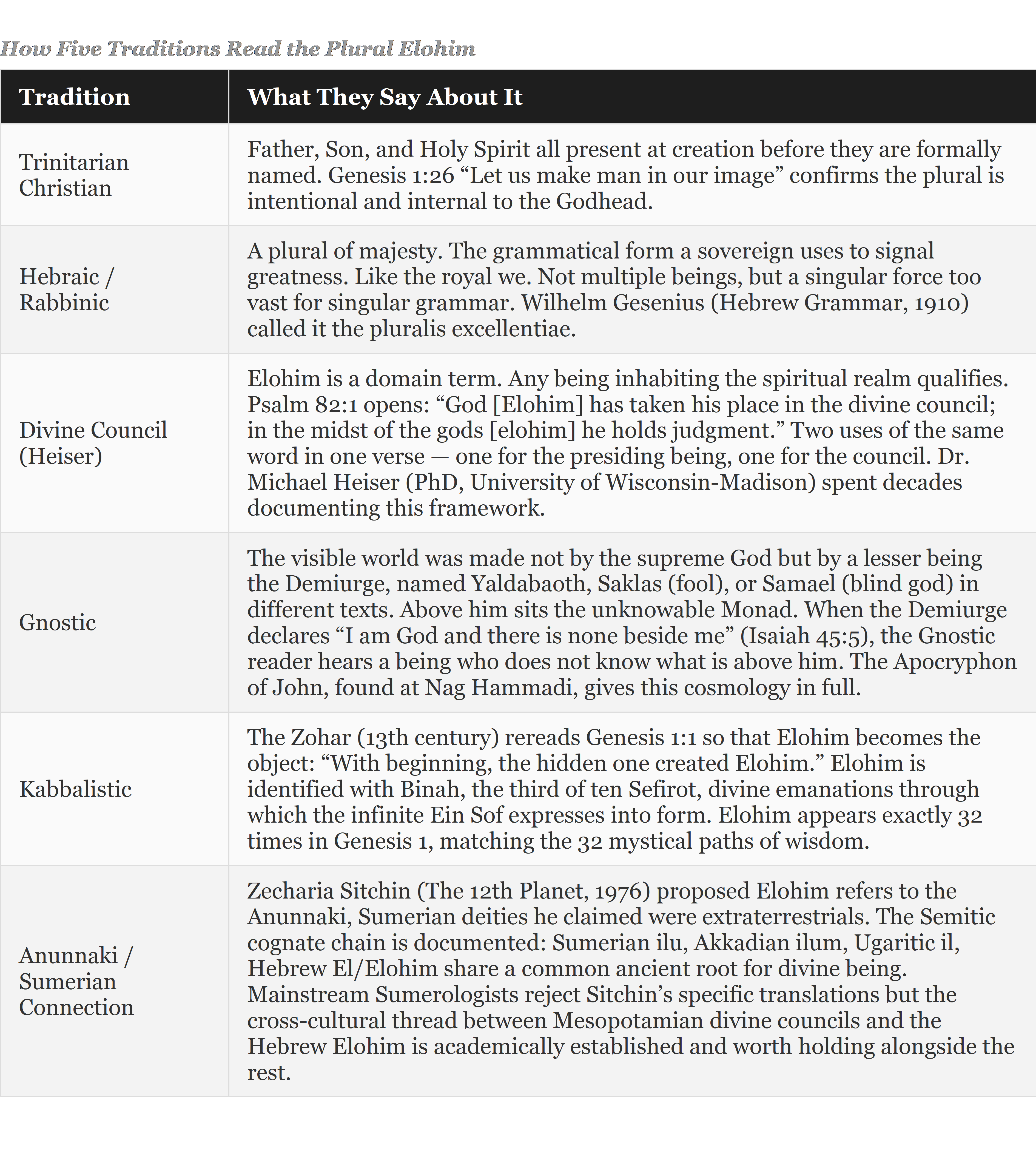
The most common Hebrew word translated as “God” in the Old Testament is Elohim. It appears approximately 2,600 times. The “-im” ending is the standard masculine plural in Hebrew. The same ending as cherubim, seraphim. And yet in over 2,000 of those occurrences, it takes a singular verb.
Right in the first sentence of Genesis:
“In the beginning God [Elohim] created the heaven and the earth.” — Genesis 1:1
Plural noun. Singular verb. The tension is baked into the text from the very first word. And what you do with it depends entirely on what tradition you are reading from.
———
Hell Is Four Different Places. None of Them Are What You Think.
The word “hell” appears 54 times in the King James Bible. Pull it up in Strong’s Concordance and you will find four completely different Strong’s numbers underneath it. Four different original words. One English translation.
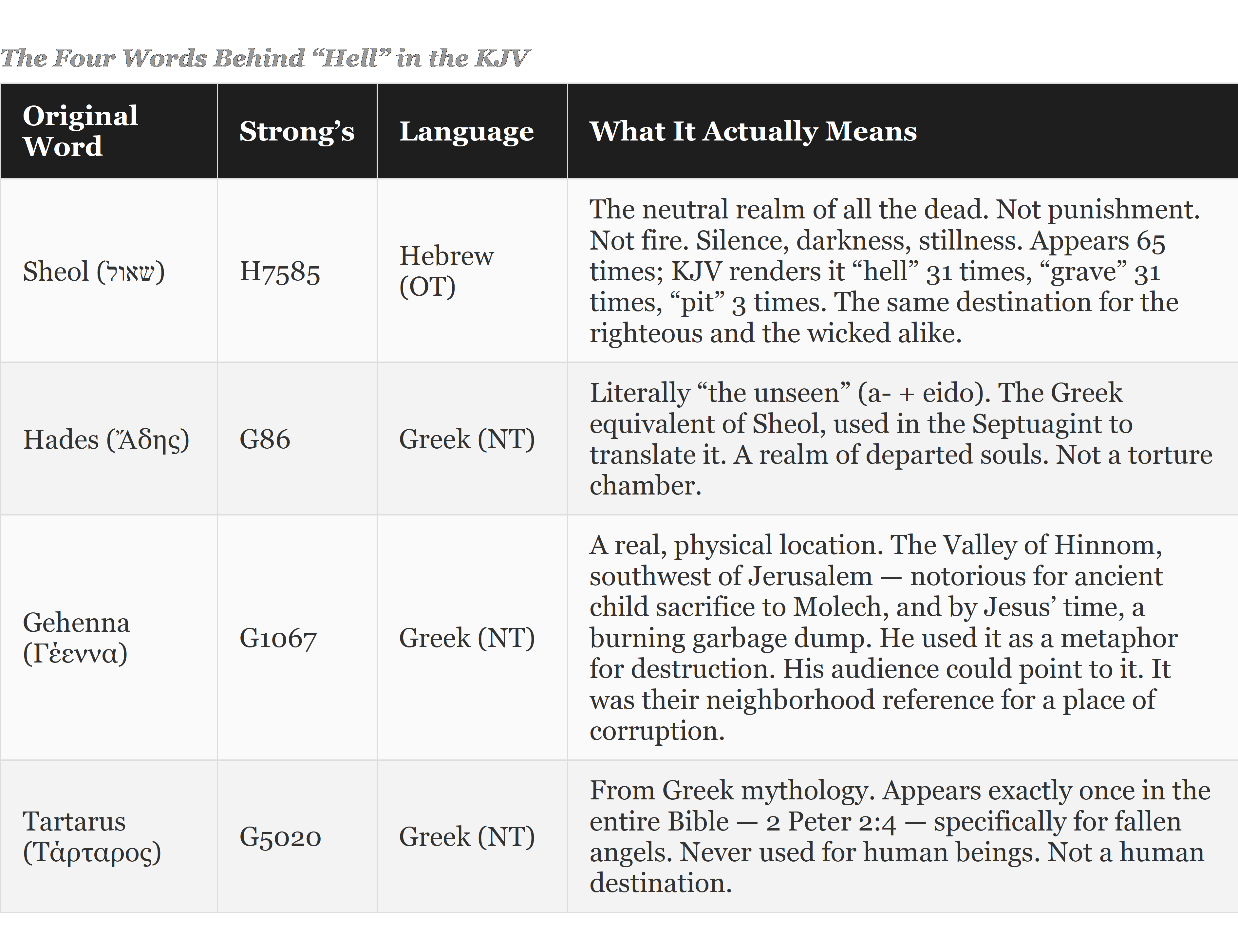
Four completely different concepts. One English word. An entire theological framework of eternal conscious torment built significantly on the collapse of those four distinctions into a single syllable.
And the ancient Hebraic understanding of death? Sheol was simply where all the dead went. Located beneath the earth. Characterized by silence, darkness, and stillness. Its inhabitants were called the Rephaim, or shades, insubstantial echoes of the living. No fire. No differential judgment. No reward or punishment based on how you lived.
“For in death there is no remembrance of thee: in the grave who shall give thee thanks?” — Psalm 6:5
The first clear statement of differential afterlife in the entire Hebrew Bible is Daniel 12:2, written around 165 BCE: “Many of those who sleep in the dust of the earth shall awake, some to everlasting life, and some to shame and everlasting contempt.” That is one of the very last books written in the Hebrew canon.
The framework of eternal hell that most Western Christians are familiar with developed through Platonic philosophy entering the tradition through Philo of Alexandria, Justin Martyr, and most powerfully through Augustine of Hippo in the 4th and 5th centuries. Plato taught that the soul is inherently immortal and destined for afterlife reward or punishment. That Greek framework merged with Christianity. The Hebraic framework did not require it.
Dante’s Inferno (1308–1321), with its nine circles of graduated torment, cemented the modern Western image. It bears no structural resemblance to anything in the Hebrew Bible. You were given a medieval Italian poet’s imagination and told it was ancient scripture.
This is not an argument that divine accountability does not exist. It is an invitation to ask what the writers were actually saying versus what a translation decision made it sound like they were saying.
———
Worship Was Never Supposed to Be Spectator Sport
The primary Old Testament word translated as “worship” is shachah (שחה, Strong’s H7812). Its primary meaning is to prostrate, or to physically press your body to the ground in total submission. It appears approximately 170 times. The KJV translates it as “worship” 99 times, “bow” 31 times, “bow down” 18 times.
Every single instance is describing a body act. Not a feeling. Not a song. Not a cognitive state. Your body on the ground. It is the posture of a defeated soldier before the one who conquered him. A subject before a king. A body fully surrendered to something greater than itself.
Every Old Testament instruction about worship is describing a physical act. An embodied practice of total surrender. Not a feeling you cultivate. Not a place you show up to. Your body acknowledging what your words say you believe.
These writers understood that spirit does not move separate from matter. That what you do with your body is theological. That posture is prayer.
How Ancient Peoples Actually Did This
In the Jerusalem Temple, worshippers prostrated themselves at each of the thirteen gates upon entering the Temple Mount. On Yom Kippur, when the High Priest spoke the divine name aloud, the entire congregation went fully to the ground. The body responding to the sacred was not optional. It was the practice.
In Egyptian worship from the Fourth Dynasty onward, roughly 2625 BCE, full prostration was called kissing the earth. In Sumerian and Babylonian practice, an entire genre of prayer was named for a body gesture. The shuila prayer, meaning raising the hands, was so characteristic of devotion that the category took the body’s name.
Lagash alone employed 62 lamentation priests and 180 vocalists. Worship was full-body, full-community, full-sensory. It was loud. It moved. It took up space.
For the first thousand years of Christianity, there were no pews in church. Worshippers stood, knelt, prostrated, moved freely. The Protestant Reformation in the 16th century shifted the sermon to the center of worship and pews arrived so people could sit through hours of preaching. By the 18th century, the body had largely been removed from Western Christian practice.
You were handed a chair where there used to be a floor.
Modern neuroscience has spent enormous resources documenting what those ancient practitioners already knew through lived practice. Full prostration simultaneously engages abdominal compression that slows breath, shifts blood pressure signaling when the head drops below the heart, and releases muscular guarding in a position of complete vulnerability. The body surrendering signals the mind that it is safe to open. That is what the practice was for. That is the theology.
That understanding is not unique to this tradition. Every serious spiritual practice on earth knows this. Which is one of the reasons the Bible belongs in conversation with other wisdom traditions rather than standing isolated from them.
———
The Tools That Let You Read It For Yourself
You do not need a seminary degree. You do not need ancient Hebrew. You need three things, and you can get two of them on your phone right now for free.
Strong’s Exhaustive Concordance
James Strong (1822–1894), while a professor at Drew Theological Seminary, spent decades creating a complete index of every word in the KJV. Published in 1890. He assigned a number to every unique Hebrew, Aramaic, and Greek root: H1 through H8674 for the Old Testament, G1 through G5624 for the New Testament.
Here is how you use it:
1. Find an English word in your KJV that you want to trace back.
2. Open Strong’s and look that word up alphabetically in the main concordance.
3. Find the specific verse you’re studying in the listings under that word.
4. The Strong’s number on the right tells you which original word was used in that verse.
5. Turn to the Hebrew or Greek dictionary in the back and look up that number.
6. If the same English word has different Strong’s numbers in different verses, that means different original words were collapsed into one English translation. That is your discovery.
Lexicons: What Strong’s Doesn’t Tell You
Strong’s gives you the word and its basic definition. A lexicon gives you everything else: the full semantic range, the etymology, the cognate languages, how the word was used across centuries, and where scholars disagree about what it means.
• Brown-Driver-Briggs (BDB): A Hebrew and English Lexicon of the Old Testament, 1906. The standard academic reference for Old Testament Hebrew. Exhaustive, rigorous, worth the time.
• Thayer’s Greek Lexicon: A Greek-English Lexicon of the New Testament, 1886. The accessible standard for New Testament Greek.
Digital Tools That Give You Everything
• Blue Letter Bible (blueletterbible.org, free) — Strong’s, BDB, Thayer’s, interlinear Bible, all integrated. Tap any word in any verse, see the original language, its definition, and every other verse it appears in. Start here.
• Bible Hub (biblehub.com, free) — 50+ parallel translations side by side, interlinear Hebrew and Greek, full lexicon entries. Excellent for seeing how differently the same verse gets rendered.
• Logos Bible Software (logos.com) — the most comprehensive scholarly platform available. The gold standard Hebrew and Greek lexicons, the Dead Sea Scrolls texts, the Theological Dictionary of the NT. This is what seminary students use.
• e-Sword (e-sword.net, free for Windows) — Strong’s inline with downloadable modules including commentaries and alternate translations.
I would also strongly suggest studying and understanding basic etymology, or the history and study of the English language. There are apps you can download to cross reference as you read.
These are not optional accessories for serious study. They are the basic equipment for reading an ancient translated text with any real integrity.
———
Everything They Quietly Removed and Where It Came From
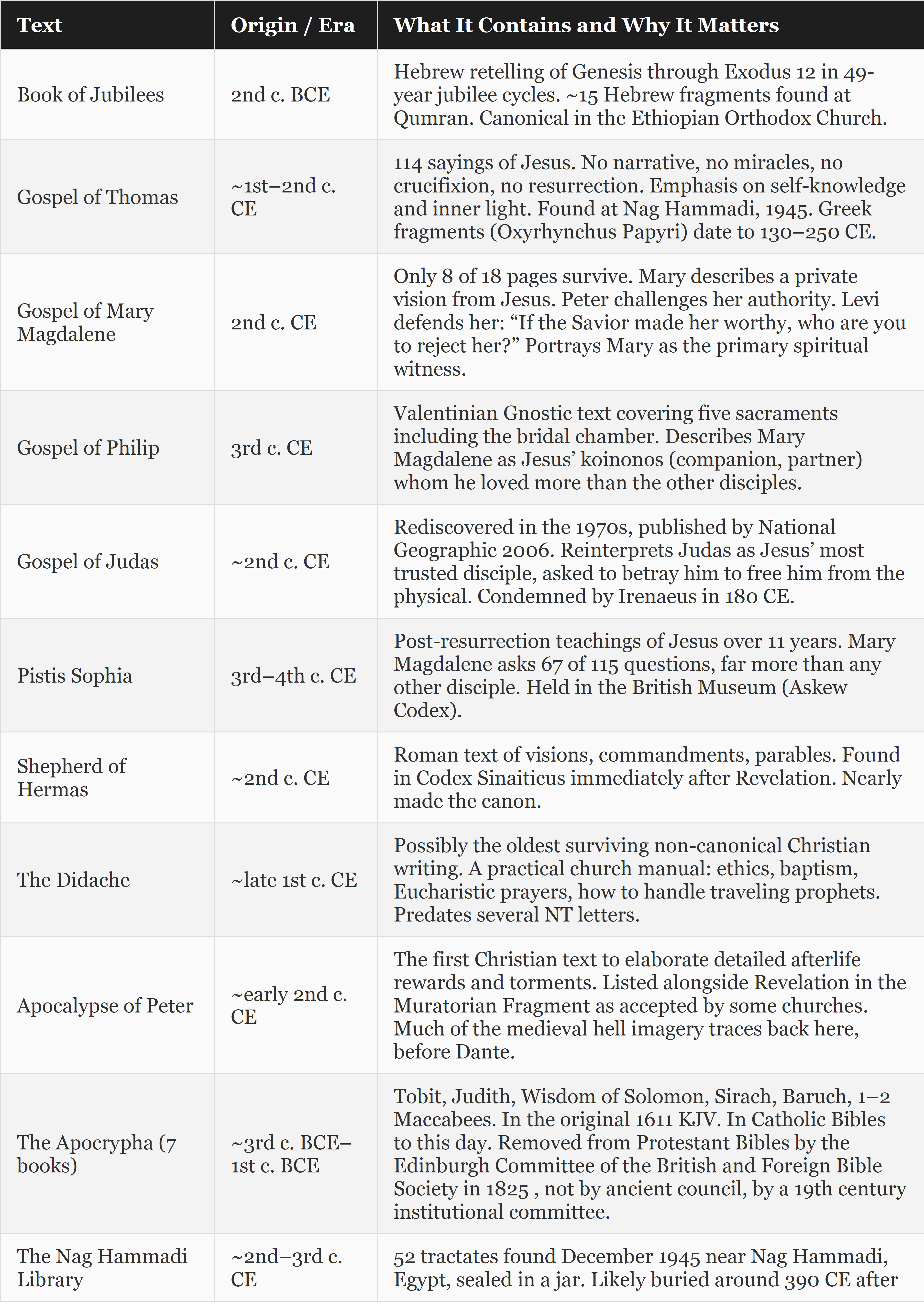
The Bible in your hands is not the complete collection of texts that were considered sacred by the communities who wrote these traditions. There were councils, debates, and votes about what stayed and what was removed. By people. In history. With institutional and political stakes involved.
This is not reason to abandon the text. It is reason to come to it with your eyes open.
The Books of Enoch
There are three. 1 Enoch, the Ethiopian Enoch, is the most significant: 108 chapters, a composite of five books spanning the 3rd century BCE to the 1st century CE. Twenty Aramaic manuscripts were found among the Dead Sea Scrolls. The complete text survives only in Ge’ez, the ancient liturgical language of Ethiopia, where it has been canonical for over 2,000 years without interruption.
Early Church Fathers Tertullian, Clement of Alexandria, and Athenagoras cited and valued it. It was excluded at the Council of Laodicea around 363–364 CE. And Jude quoted it directly in your Bible:
“And Enoch also, the seventh from Adam, prophesied of these, saying, Behold, the Lord cometh with ten thousands of his saints, To execute judgment upon all…” — Jude 1:14–15
That passage is 1 Enoch 1:9. Word for word. Jude treated Enoch’s text as prophetic scripture. Then the councils removed it.
2 Enoch describes Enoch’s ascent through ten heavens. 3 Enoch describes his transformation into the archangel Metatron, called the Lesser YHWH. These traditions existed. They were read. They were set aside by institutional decisions, not by anything in the text itself
Full Account Of Removed Sacred Texts
———
They Gutted the Bible and Signed Their Name to It
In 1807, British missionaries published something called Select Parts of the Holy Bible, for the use of the Negro Slaves, in the British West-India Islands. Printed in London by Law and Gilbert. The editorial direction came from Beilby Porteus, Bishop of London. They put the purpose in the title.
A standard Protestant Bible has 1,189 chapters. The Slave Bible has 232. Approximately 90 percent of the Old Testament was removed. About half the New Testament.
What was cut:
• Exodus entirely. The whole story of God intervening to free an enslaved people. Gone.
• Luke 4:18. Jesus announcing his ministry:
“The Spirit of the Lord is upon me, because he hath anointed me to preach the gospel to the poor; he hath sent me to heal the brokenhearted, to preach deliverance to the captives, and recovering of sight to the blind, to set at liberty them that are bruised.” — Luke 4:18
• Galatians 3:28: “There is neither Jew nor Greek, there is neither bond nor free, there is neither male nor female: for ye are all one in Christ Jesus.” Gone.
• The Book of Revelation. Gone.
• Ephesians 6:5 stayed: “Servants, be obedient to them that are your masters.” That one made every cut.
Three known copies survive. One is held at Fisk University in Nashville. One at the University of Glasgow. The Museum of the Bible in Washington D.C. exhibited it in 2018.
The Slave Bible did not invent something new. It just did openly what politically motivated translation has always done with more sophistication. Every version of the Bible that exists was touched by someone with stakes in what it said. The Slave Bible is just the one that stopped pretending otherwise.
———
What the Dead Sea Scrolls Cracked Open
Discovered between 1946 and 1956 in eleven caves near Qumran by the Dead Sea. 972 manuscripts dating from roughly 250 BCE to 115 CE. They pushed the earliest known Hebrew Bible manuscripts back by a full thousand years and what scholars found permanently changed the conversation about textual authority.
Roughly 60 percent of the Dead Sea Scrolls biblical manuscripts look like the Masoretic Text we already had. The other 40 percent do not. Some align with the Samaritan Pentateuch. Some align with the Septuagint. Some do not align with anything. Multiple textual traditions were circulating simultaneously before a single one got standardized.
• Deuteronomy 32:8: The Masoretic Text reads “sons of Israel.” The Dead Sea Scrolls (4QDeutj) read “sons of God.” The Septuagint reads “Angels of God.” Scholar Emanuel Tov calls the Masoretic reading an anti-polytheistic alteration. A later scribe changed “sons of God” to remove implications of a divine council. Israel did not yet exist at the Babel event being described, which makes the Masoretic reading anachronistic in its own context.
• Jeremiah: The Dead Sea Scrolls and Septuagint version of Jeremiah is approximately one-eighth shorter than the Masoretic version, with the Oracles Against the Nations in a completely different location. These are not minor variants. They are two different literary editions of the same book.
• Goliath’s height: Dead Sea Scrolls and Septuagint say 4 cubits (about 6 feet 9 inches). The Masoretic Text says 6 cubits (about 9 feet 9 inches). Different manuscripts. Different giant.
• The Psalms Scroll (11QPsa): Contains 41 canonical Psalms plus 7 apocryphal ones in a radically different order. The Psalter may still have been an open collection, though not yet finalized, when these manuscripts were written.
Eugene Ulrich of the University of Notre Dame concluded that future translations should be less rigidly tied to the Masoretic Text. The Dead Sea Scrolls showed that the Hebrew Bible was a living, plural tradition for centuries before any single version became the version.
The text you were handed as singular and authoritative was never singular.
———
So What Do You Do With All of This?
You do not need to learn ancient Hebrew. You do not need a seminary degree. You need a phone and fifteen minutes and the willingness to look.
Read the text like a whole book, not scripture by scripture in isolation. Context is everything. A verse pulled out of its literary, cultural, and historical context does not mean what it sounds like standing alone. That is not interpretation. That is decoration.
Put it in conversation with other ancient wisdom traditions instead of treating it as a sealed system. The Hermetic texts. The Book of Enoch. The Vedas. The Nag Hammadi gospels. The oral traditions that colonization worked so hard to erase. The divine did not only speak once to one group of people. These traditions are in dialogue with each other, and reading them that way is how you start to hear what they are all pointing toward.
And ask the questions you were told not to ask. Who translated this? When? Why? Who funded it? What was the political situation? What does this word actually mean in the original? What got left out of this version and why?
I came from this tradition. I still hold it. What I found on the other side of the questions did not take anything away from what was already there. It made it deeper.
The text has always been asking you to go further in. You just needed someone to tell you that asking was allowed.
It is. Go look.
———
Works Cited & Recommended Reading
Start Here — Primary Tools
• Strong, James. The Exhaustive Concordance of the Bible. Hunt & Eaton, 1890. Available free at BlueLetterBible.org and BibleHub.com.
• Brown, Francis, S.R. Driver, and Charles A. Briggs. A Hebrew and English Lexicon of the Old Testament (BDB). Oxford: Clarendon Press, 1906. Hendrickson reprint, ISBN 978-1565632066.
• Thayer, Joseph Henry. A Greek-English Lexicon of the New Testament. Harper & Brothers, 1886. Hendrickson reprint, ISBN 978-1565632097.
• Gesenius, Wilhelm. Gesenius’ Hebrew Grammar. Ed. E. Kautzsch, trans. A.E. Cowley. 2nd English ed. Oxford: Clarendon Press, 1910.
On the Hebrew Bible, Textual Transmission, and the Dead Sea Scrolls
• Tov, Emanuel. Textual Criticism of the Hebrew Bible. 3rd rev. ed. Minneapolis: Fortress Press, 2012. ISBN 978-0800696641.
• Ulrich, Eugene, Martin Abegg Jr., and Peter Flint. The Dead Sea Scrolls Bible. San Francisco: HarperSanFrancisco, 1999. ISBN 978-0060600648.
• Vermes, Geza. The Complete Dead Sea Scrolls in English. 7th rev. ed. London: Penguin, 2011. ISBN 978-0141197319.
• Cross, Frank Moore. The Ancient Library of Qumran. 3rd rev. ed. Sheffield Academic Press, 1995. ISBN 978-1850757085.
On the Elohim, Divine Council, and Spiritual Cosmology
• Heiser, Michael S. The Unseen Realm: Recovering the Supernatural Worldview of the Bible. Bellingham, WA: Lexham Press, 2015. ISBN 978-1577995562.
• Heiser, Michael S. “Deuteronomy 32:8 and the Sons of God.” Bibliotheca Sacra 158 (2001): 52–74.
• Sitchin, Zecharia. The 12th Planet. New York: Stein and Day, 1976. ISBN 978-0380393626. (Note: Sitchin’s specific translations are contested by mainstream Sumerologists, but the cross-cultural Semitic cognate thread is academically documented.)
• Mullen, E. Theodore. The Assembly of the Gods. Chico, CA: Scholars Press, 1980.
On the Book of Enoch and Related Texts
• Charles, R.H. The Book of Enoch, or 1 Enoch. 2nd ed. Oxford: Clarendon Press, 1912. Dover reprint, ISBN 978-0486454665.
• Nickelsburg, George W.E., and James C. VanderKam. 1 Enoch: The Hermeneia Translation. Minneapolis: Fortress Press, 2012. ISBN 978-0800699109.
• VanderKam, James C. The Dead Sea Scrolls Today. 2nd ed. Grand Rapids: Eerdmans, 2010.
On Gnostic Texts and the Nag Hammadi Library
• Pagels, Elaine. The Gnostic Gospels. New York: Random House, 1979. Vintage ISBN 978-0679724537.
• Pagels, Elaine. Beyond Belief: The Secret Gospel of Thomas. New York: Random House, 2003.
• Layton, Bentley. The Gnostic Scriptures. Garden City, NY: Doubleday, 1987.
On Kabbalah and Mysticism
• Scholem, Gershom. Major Trends in Jewish Mysticism. Rev. ed. New York: Schocken Books, 1946. ISBN 978-0805210422.
• Matt, Daniel (trans.). The Zohar: Pritzker Edition. 12 vols. Stanford: Stanford University Press, 2004–2017.
On Afterlife and Death Theology
• Johnston, Philip S. Shades of Sheol: Death and Afterlife in the Old Testament. Downers Grove, IL: IVP Academic, 2002.
• Ehrman, Bart D. Heaven and Hell: A History of the Afterlife. New York: Simon & Schuster, 2020. ISBN 978-1501136733.
On the Slave Bible
• Select Parts of the Holy Bible, for the use of the Negro Slaves, in the British West-India Islands. London: Law and Gilbert, 1807. Copies held at Fisk University (Nashville) and University of Glasgow Special Collections.
• Museum of the Bible. “The Slave Bible: Let the Story Be Told.” Exhibition, Washington D.C., 2018.
On Translation History and the Names of God
• Lamsa, George M. The Holy Bible from Ancient Eastern Manuscripts. Philadelphia: A.J. Holman, 1957. HarperOne reprint, ISBN 978-0060649265.
• Kittel, Gerhard, and Gerhard Friedrich, eds. Theological Dictionary of the New Testament (TDNT). 10 vols. Grand Rapids: Eerdmans, 1964–1976.
 Lady Arelia
Leave a comment